Eighty-seven. That number sat next to the temperature in my weather app for roughly two years, and for roughly two years I had no idea what it was telling me. Something about the air. That was the extent of it.
When I finally went looking for an answer, I landed in a federal technical document full of breakpoint concentrations and eight-hour rolling averages, and I closed the tab feeling dumber than when I opened it.
Nobody had said the plain version out loud: the air quality index measures health risk, not how much junk is floating around out there. One sentence. It would have saved me two years.
TL;DR Quick Answers
aqi meaning
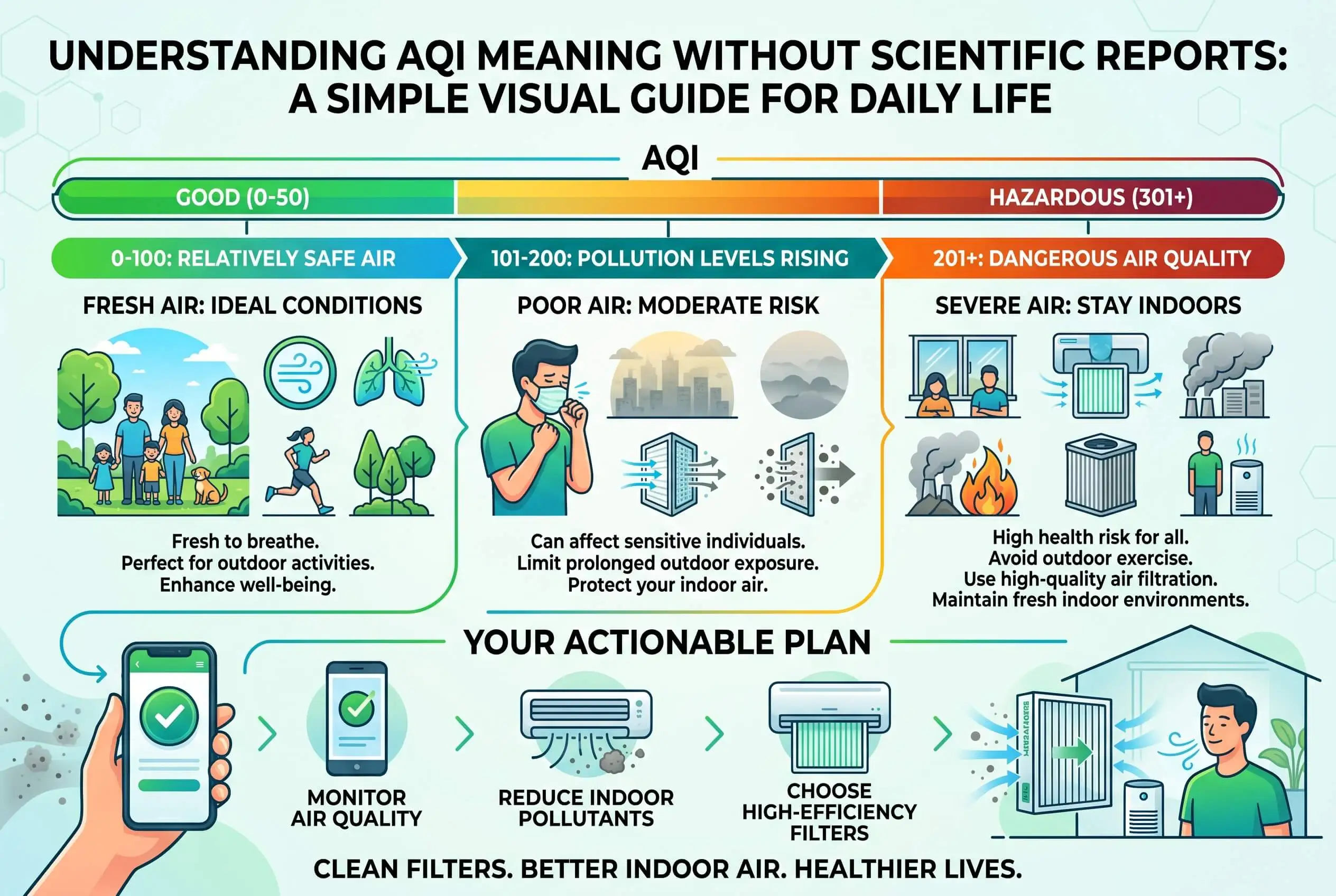
AQI stands for Air Quality Index, a 0 to 500 scale the EPA uses to report how much health risk comes with breathing outdoor air right now. Higher means more risk. It isn't a percentage, and whichever single pollutant scores highest that day sets the number you see.
Not a percentage. An AQI of 100 is neither a midpoint nor a maximum. It sits near the short-term national health standard.
One pollutant drives it. The highest individual index value becomes the reported AQI, and every other reading drops out.
Three numbers exist. The daily AQI, the next-day forecast, and the live NowCast reading come from different calculations, so expect them to disagree.
Above 100 is the line. Sensitive groups feel it first, then everyone else as the number climbs.
The driver changes the plan. Ozone means shift your timing. Particles mean go inside.
Top Takeaways
The AQI scores health risk from outdoor air, not how dirty the air looks.
One pollutant sets the number you see. Every other reading gets dropped.
Naming the pollutant behind the score tells you whether to shift your timing or head indoors.
The daily AQI, the next-day forecast, and the live NowCast reading come from three different calculations, so expect them to disagree.
Kids, older adults, and anyone with a heart or lung condition should act at a lower number than everyone else.
What the AQI Number Is Actually Telling You
It's a health-risk score, not a cleanliness rating
I read the AQI as a dirt gauge for years, which is the wrong question asked in the wrong direction. The index measures something narrower and more useful than that: how much health risk comes with breathing the outdoor air right now.
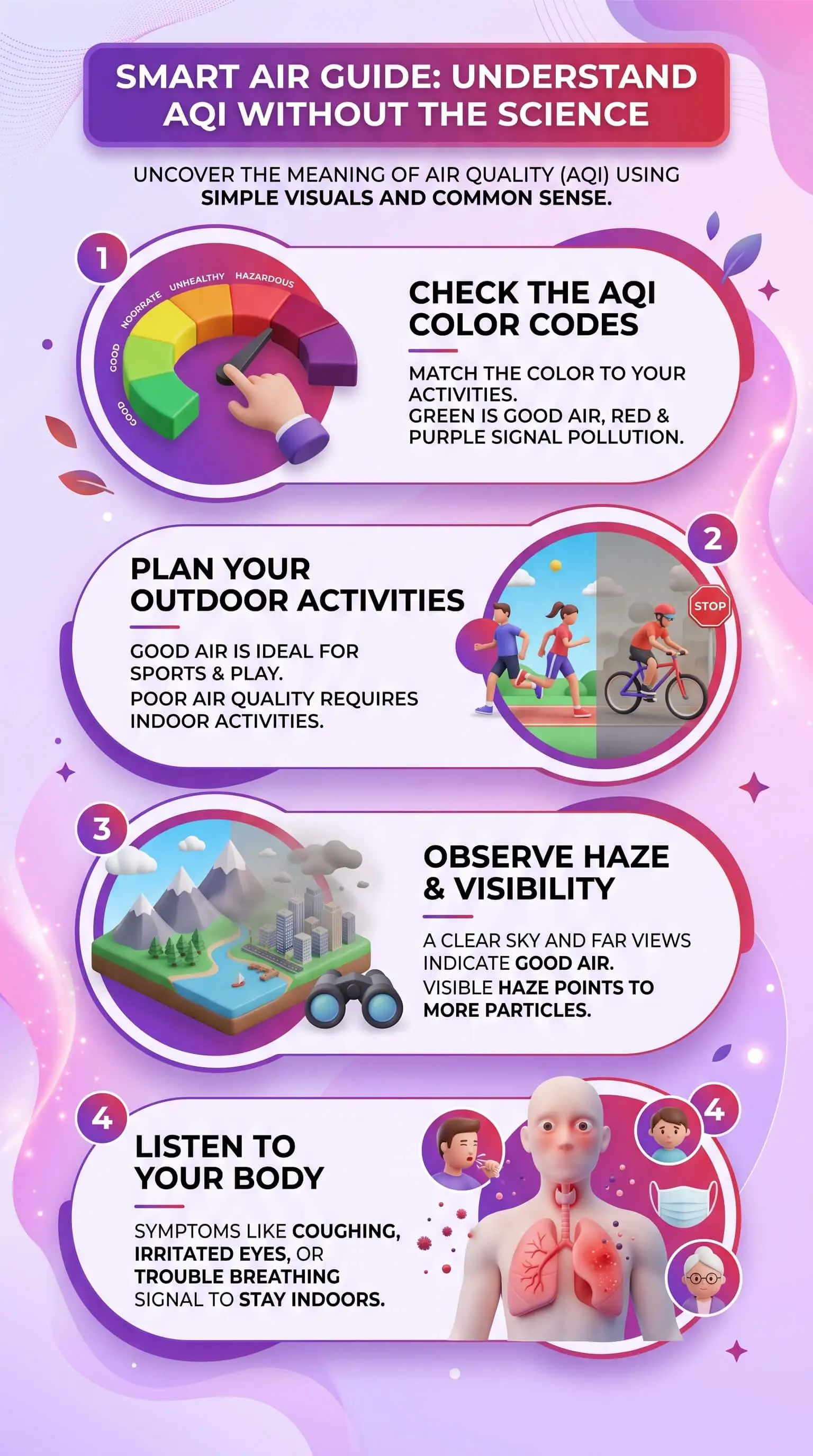
Which finally explained the days that never made sense to me. Grey, gritty-looking mornings reading 58. Clear blue afternoons reading 132, because ozone doesn't show up in photographs. That’s why understanding AQI meaning matters: judge the air by looking at it and you're guessing, and I guessed wrong plenty of times before I quit.
Why 100 doesn't mean the air is 100 percent polluted
AQI isn't a percentage, though almost everyone I've explained this to had assumed it was. The scale runs 0 to 500. An index value of 100 lands roughly on the short-term national health standard for whichever pollutant is highest that day, so at or below 100, the air is generally considered satisfactory. Climb past it and conditions turn unhealthy, first for sensitive groups, then for everybody.
The math isn't linear, either. An AQI of 300 doesn't carry twice the harm of 150. If you want the full breakdown of what each number on the 0 to 500 scale means, color bands and matching responses included, read it once and you'll have it for good.
One pollutant sets the score, and the rest get thrown out
Here's the part nobody told me, and it changed how I read the number entirely. The EPA runs a separate index calculation for every pollutant it tracks: ground-level ozone, PM2.5, PM10, carbon monoxide, sulfur dioxide, and nitrogen dioxide. Whichever one comes out highest becomes the reported AQI. The rest disappear.
So the number on your screen is a single pollutant wearing a general-purpose label. Ozone at 62 and PM2.5 at 118 gives you a 118, and the ozone never comes up at all. Two cities can post identical 110s and still need completely different things from the people living in them.
Ozone runs on a clock, particles run on the weather
Once I started asking which pollutant was driving the score, the number stopped nagging at me and started earning its place on the screen.
Ozone forms when sunlight cooks the emissions coming off traffic and industry, so it builds through hot afternoons and eases back after sundown. When ozone is the driver on a marginal day, I move my run to 7 a.m. and the problem takes care of itself.
Particles don't care what time it is. Smoke drifting in from a fire three states away keeps the number high overnight and straight through the next day, so rescheduling buys you nothing. Closing the house up and running the system does. That's the same instinct behind my Chicago air quality checklist.
You're probably looking at three different numbers
This one confused me longer than anything else on the list. There's a daily reported AQI, a next-day forecast, and a live reading called the NowCast. Three separate calculations. They aren't supposed to match.
The daily AQI sums up a whole day. The forecast goes out the afternoon before, issued by state and local forecasters who fold in weather models, satellite images, and their own read on how pollution behaves in their particular city. The NowCast leans hard on the most recent hours, which is why it moves quickly during a smoke event while a flat 24-hour average would still be catching up. When somebody tells me their app disagrees with the news, this is almost always why.
The monitor might be nowhere near you
Metro areas above 350,000 people have to report a daily AQI. Plenty of smaller places do it voluntarily. Live rurally, though, and your reading could be coming off a monitor sitting well outside the air you actually breathe, so I take those numbers as directional and leave it at that.
One more thing, and I mean it. If you've got a diagnosed heart or lung condition, talk to your doctor about what your threshold should be, and learn how different types of air purifiers can support cleaner indoor air. A number on a scale isn't a diagnosis.
"I quit asking whether the air was bad and started asking which pollutant made it bad. That one switch turned the AQI from a number that nagged at me into a number that told me what to do with my afternoon, including when to pay more attention to pleated furnace filters indoors."
7 Essential Resources
Decode the Colors Straight From the Agency That Sets Them
AirNow: AQI Basics covers all six color categories, the value range behind each one, and the five pollutants the index tracks. Everything else you'll read quotes this page. Source: U.S. Environmental Protection Agency.
Tell Today's Number Apart From Tomorrow's Forecast
AirNow: Using the Air Quality Index sets the daily index, the forecast, and the NowCast side by side and names who issues each one. If the three-numbers problem tripped you up, start here. Source: U.S. Environmental Protection Agency.
Work Backward From a Number to an Actual Concentration
AirNow: AQI Calculator converts an index value into the pollutant concentration sitting behind it. Run 150 through it, then run 300, and you'll see exactly how non-linear this scale is. Source: U.S. Environmental Protection Agency.
See Why Fine Particles Matter More Than the Ones You Can Spot
EPA: Particulate Matter (PM) Basics splits PM10 from PM2.5, traces where each one comes from, and explains why the smallest particles travel deepest. A human hair runs about 30 times wider than the largest fine particle. Source: U.S. Environmental Protection Agency.
Find Out Whether You Belong to a Sensitive Group
AirNow: Asthma and Heart Disease walks through how ozone and particle pollution act on people with lung and heart conditions, and who should be working from a lower threshold. Source: U.S. Environmental Protection Agency.
Track Smoke That Traveled Hundreds of Miles to Reach You
AirNow Fire and Smoke Map maps PM2.5 from wildfires and other sources in near real time. The EPA and the U.S. Forest Service built it together. Source: U.S. Environmental Protection Agency.
Keep the Live Reading in Your Pocket
AirNow Mobile App shows current and forecast AQI for any location you save, with the fire and smoke map built in. Free on both app stores. Source: U.S. Environmental Protection Agency.
These resources help you read AQI, identify the pollutant driving the score, track smoke and changing conditions, and understand why high quality filters matter when outdoor pollution starts affecting the air inside your home.
3 Statistics
44 percent of Americans, or 152.3 million people, live in counties carrying failing grades for ozone or particle pollution. American Lung Association, State of the Air 2026
Americans spend roughly 90 percent of their time indoors, where some pollutants run 2 to 5 times higher than typical outdoor levels. EPA Report on the Environment Outdoor air still finds its way in, which is why a well-matched filter and purifier setup earns its keep on high-AQI days.
About 109 million people lived in counties with pollution above the primary national standard in 2024. EPA: Air Quality National Summary
44 percent of Americans, or 152.3 million people, live in counties carrying failing grades for ozone or particle pollution. American Lung Association, State of the Air 2026
Americans spend roughly 90 percent of their time indoors, where some pollutants run 2 to 5 times higher than typical outdoor levels. EPA Report on the Environment Outdoor air still finds its way in, which is why a well-matched filter and purifier setup earns its keep on high-AQI days.
About 109 million people lived in counties with pollution above the primary national standard in 2024. EPA: Air Quality National Summary
These statistics show why outdoor AQI matters even when you spend most of your time inside, and MERV 8 pleated HVAC furnace air filters can help reduce some of the airborne particles that enter and circulate through the home.
Final Thoughts and Opinion
People treat the AQI like an alarm, and I'd argue that's precisely why they tune it out. Alarms demand a reaction. This number usually isn't asking for one. Most days it tells me nothing needs to change, which is information worth having.
I've landed on treating it the way I treat the temperature. Forty degrees doesn't send me into a panic, it sends me to the coat closet. The AQI works the same once you know what it measures and what's pushing it.
Those technical documents exist because regulators need decimal-place precision. You don't. You need to know whether you're above 100, which pollutant put you there, whether anybody under your roof should be working from a lower threshold than the rest of you, and how to test indoor air quality when you want to understand the air inside your home too. That's the whole job.
Frequently Asked Questions
What does AQI stand for?
AQI stands for Air Quality Index. It's the EPA's system for reporting outdoor air quality on a 0 to 500 scale across six color-coded categories, so you can read the health risk without interpreting pollutant concentrations yourself.
Is an AQI of 100 bad?
An AQI of 100 sits at the top of the Moderate range and lines up roughly with the short-term national health standard, so it's generally considered satisfactory. Past 100, the air turns unhealthy for sensitive groups first, then for everyone as the number rises.
Is AQI a percentage?
No. An AQI of 100 doesn't mean the air is 100 percent polluted. The scale runs to 500 and isn't linear, so an AQI of 300 doesn't represent twice the health risk of an AQI of 150.
Why does the AQI change during the day?
Because air quality moves. Ozone builds through hot, sunny afternoons and drops off after sunset, while particle pollution shifts with wind and smoke. The live NowCast reading weights recent hours more heavily, so it updates faster than a flat daily average would.
Does AQI measure the air inside my house?
No. AQI covers outdoor air only. Outdoor pollution still reaches you indoors through windows, doors, gaps in the building envelope, attic insulation installation areas, and your HVAC system, which is why the outdoor number matters even on days you never leave.
What AQI is safe for kids and older adults?
Children, older adults, and people with heart or lung conditions should work from a lower threshold than the general public. They can feel effects starting in the 101 to 150 range, while most people typically don't until the number passes 150.