
That gap in the numbers confuses a lot of people. Nursing students run into it before exams. Teachers hit it when they print a poster for the classroom sink. Parents ask us about it at school pickup, usually with a toddler on one hip.
We're Dr. Ruslan Maidans (PhD, Biomedical Engineering) and Dr. Yalda Shahriari (DDS). We spent two years developing NOWATA, a plant-based soap that works without water, and that work forced us to study hand washing one motion at a time. We had to know which surface each step reaches and which ones people skip.
What we found:
The 7 steps and the WHO method teach the same core movements in the same order
Every difference between them comes down to counting and timing
Thumbs, fingertips, and the backs of the fingers get missed no matter which version someone learned
Knowing the steps rarely guarantees people actually do them
TL;DR Quick Answers
7 steps of hand hygiene
The 7 steps of hand hygiene are the six World Health Organization rubbing motions plus the wrists. Wet your hands, apply soap, and scrub for at least 20 seconds:
Rub palm to palm
Rub the back of each hand, fingers interlaced
Rub palm to palm, fingers interlaced
Rub the backs of your fingers against the opposite palm
Twist each thumb in the opposite hand
Rub your fingertips in circles in the opposite palm
Rotate each wrist in the opposite hand
Rinse and dry with a clean towel.
What we see most as doctors and parents: people skip steps 4, 5, and 6, the backs of the fingers, the thumbs, and the fingertips, which is where bacteria build up most. No sink nearby? Apply a rinse-free soap like NOWATA to dry hands, rub through all seven steps until it clumps, and brush it off.*
Top Takeaways
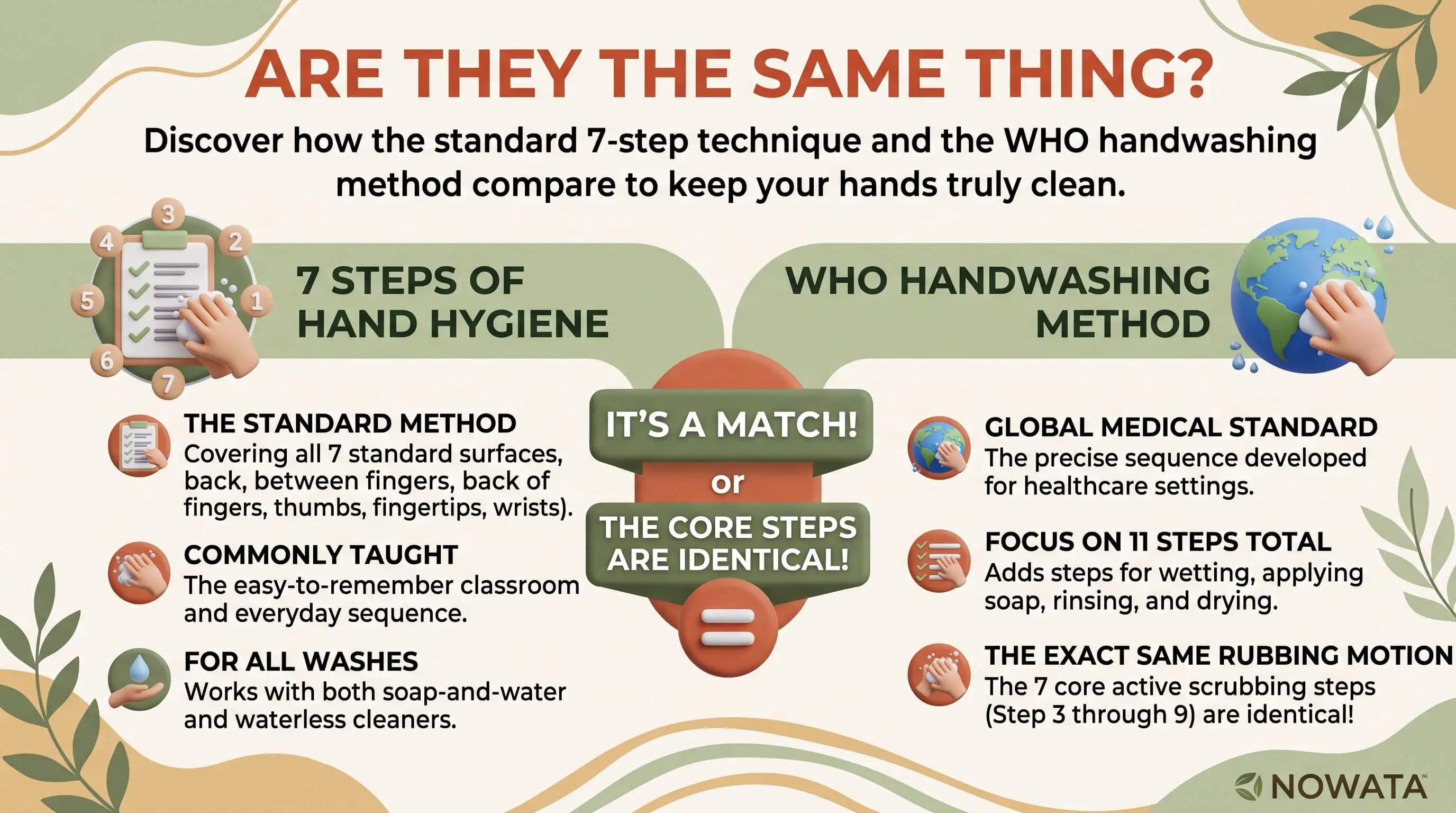
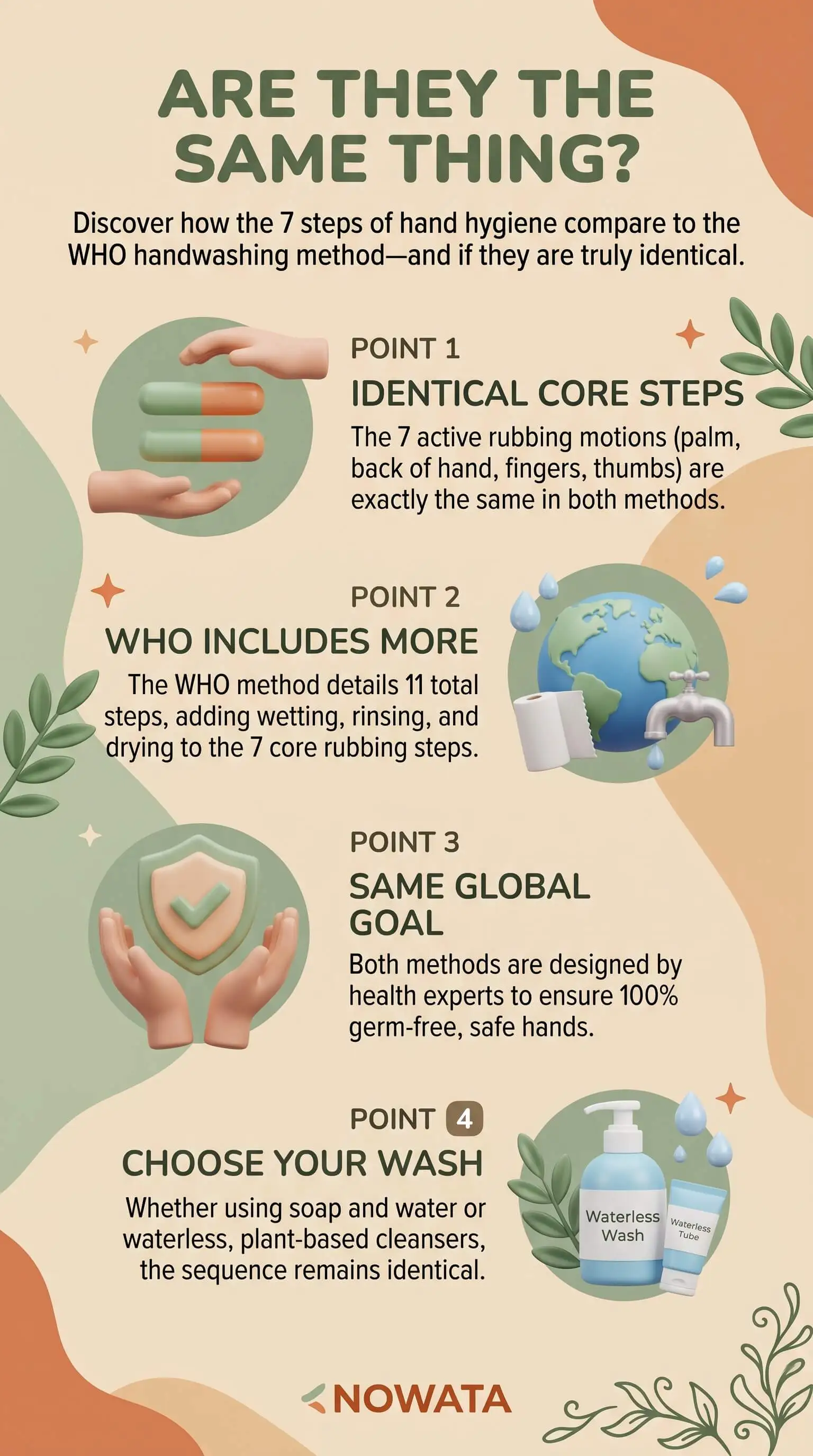
The 7 steps and the WHO method share their motions and differ in how they count them.
Six rubbing motions, same order, in both
The usual seventh step is the wrists, which WHO's poster leaves out
Some charts count "wet and soap" as step 1 instead
The two clocks time different things.
WHO's 40 to 60 seconds runs from wet hands to tap off
The CDC's "at least 20 seconds" covers only the scrub
Both methods trace back to one 1978 technique.
Graham Ayliffe's team published the six core motions for hospitals
WHO adopted them in 2009, and 7-step charts grew out of local adaptations
Coverage counts for more than the step number.
Thumbs, fingertips, and the backs of the hands get missed most
In a 2025 study, 43% of staff did all six steps right at first, and 97% did after a short video
In a 2016 trial, only 65% of clinicians finished WHO's six steps
You can run all seven steps with or without a sink.
Soap and water is still the first choice whenever it's available
Sanitizer uses the same motions but leaves dead germs and dirt behind
NOWATA's rinse-free formula lets you do every step with no water*
Same Motions, Different Counting: The 7 Steps vs. the WHO Method Side by Side
Lay the two methods next to each other and the overlap is almost total. Here's each motion with its number on WHO's How to Handwash poster and on a typical 7-step chart:
Wet hands and apply soap: WHO steps 0 and 1; done before step 1 on most 7-step charts, though some call it step 1
Rub palm to palm: WHO step 2, 7-step step 1
Rub the back of each hand with fingers interlaced: WHO step 3, 7-step step 2
Palm to palm with fingers interlaced: WHO step 4, 7-step step 3
Backs of fingers against the opposite palm: WHO step 5, 7-step step 4
Rotate each thumb in the opposite palm: WHO step 6, 7-step step 5
Rub fingertips into the opposite palm: WHO step 7, 7-step step 6
Rotate each wrist in the opposite hand: missing from the WHO poster, 7-step step 7
Rinse, dry with a single-use towel, and turn off the tap with the towel: WHO steps 8 to 11, usually an unnumbered finish on 7-step charts
Total time: WHO allows 40 to 60 seconds for the whole routine, while most 7-step charts ask for at least 20 seconds of scrubbing
Where they match:
Six identical friction motions, in the same order
The same goal of getting soap and friction onto every surface of both hands
Where they differ:
The 7-step version adds the wrists
WHO numbers the prep and the finish
WHO times the full routine, and the 20-second rule times only the scrub
WHO's poster tells you to wash only when hands are visibly dirty and to use handrub the rest of the time
What Are the 7 Steps of Hand Hygiene?
Take off the rings and watch first. Wet your hands, then use enough soap to cover every surface.
Rub palm to palm. It covers the most skin, and it's where most people quit.
Rub the back of each hand with the opposite palm, fingers interlaced. In a 2025 nursing study, 59% of healthcare staff missed the backs of their hands on the first try.
Rub palm to palm with your fingers interlaced to reach the spaces between them.
Lock your fingers and rub their backs against the opposite palm, which gets the knuckles and joints.
Clasp each thumb in the other hand and twist. Because thumbs sit apart from the other fingers, a palm rub barely touches them.
Rub your fingertips in small circles in the opposite palm. The skin around the nails carries more bacteria than anywhere else on the hand.
Grip each wrist in the opposite hand and rotate.
Rinse under clean running water and dry well with a clean towel.
While we were developing NOWATA, we watched a lot of adults wash their hands, and most of them unconsciously skipped steps 4, 5, and 6. Those happen to be the spots where bacteria pile up. For the full routine, plus the five moments when it matters most, read our full guide to the 5 moments and 7 steps of hand hygiene.
What the WHO Handwashing Method Actually Includes
WHO published its How to Handwash poster in May 2009 with the University of Geneva Hospitals. It numbers twelve images, 0 through 11, and gives you 40 to 60 seconds for the whole thing.
0 and 1: wet your hands, then apply enough soap to cover all surfaces
2 through 7: the six rubbing motions, palm to palm through fingertips
8 through 10: rinse, dry with a single-use towel, and use that towel to shut off the faucet
11: "Your hands are now safe"
Across the top, in capital letters, the poster says to wash hands when visibly soiled and otherwise use handrub. People tend to skim past that line. It tells you who the poster was written for: health workers who clean their hands dozens of times a shift, mostly with alcohol rub.
Where the 7 Steps Came From
The motions are older than either chart.
1978: Graham Ayliffe and colleagues publish a six-step technique for health care, with each motion repeated five times over about 30 seconds.
2009: WHO adopts those six motions in its hand hygiene guidelines and posters.
In the years since: hospitals, nursing schools, and public health programs in many countries teach a seventh step, most often the wrists.
2025: a study in the British Journal of Nursing tests yet another seventh step, this one aimed at the backs of the hands.
So when you see a 7-step chart, you're looking at a local version of WHO's technique, with the same parents.
Why Different Sources Give Different Step Counts
You may have seen six steps, seven, ten, or twelve. They're four ways of counting one technique.
Prep and finish: WHO numbers wetting, rinsing, and drying, and most 7-step charts leave them out.
Wrists: some charts add them, and the WHO poster doesn't.
The clock: WHO's 40 to 60 seconds covers everything from tap on to tap off, while the CDC's 20 seconds covers scrubbing.
Wash versus rub: WHO has a separate handrub poster for alcohol products, with the same motions and a shorter time.
If every surface of both hands gets friction, the number printed on the poster matters a lot less than the habit.
Which Version Should You Follow?
That depends on where you're standing.
In a hospital or clinic: follow your facility's protocol, which is almost always built on the WHO method.
Studying for a nursing or medical exam: learn the version your program teaches, since the answer key will follow it.
At home, in a classroom, or in a kitchen: pick any version that reaches the thumbs, fingertips, backs of the hands, and wrists. The wrist step adds a few seconds.
With little kids: keep it simple. We tell ours to "rub like you're putting on invisible gloves," then we check their thumbs.
With no sink nearby: run the same motions with a rinse-free soap, covered in the next section.
Soap, Sanitizer, or No Water: Do the Steps Change?
The motions stay the same whatever you're using. What changes is where the germs end up.
Soap and water lift dirt, oil, and germs off your skin and send them down the drain, which is why the CDC calls it the best option whenever a sink is available. Alcohol sanitizer uses the same rubbing pattern but kills germs chemically and leaves them on your skin along with any dirt. It also works poorly on visibly dirty hands.
And then there's the moment with no sink at all. As parents, we kept hitting it on hiking trails, at soccer practice, and in the car before snack time. Most families skip hand hygiene completely in those moments, and that gap is the reason we built NOWATA.
NOWATA is a plant-based soap you apply to dry hands. Rub through all seven steps until the formula clumps, then brush the clumps away, and the dirt and germs go with them. In laboratory testing, that process physically removed over 99.9% of tested virus and bacteria particles.* We noticed something else during testing too. Adults and kids both spent longer on each step because they could watch the formula working.
If you wash your hands all day, which soap you use matters too, and we've written about that separately.
Clean Hands, Clean Air
Germs get around a home in two main ways, on hands and through the air. Good technique handles the hands. Ventilation and filtration handle the air. If you're already thinking about cleaning the air in your home, the 7 steps are the other half of that habit.
"Parents ask us all the time whether six steps or seven is the right answer, as if the number is what keeps a family healthy. We tested NOWATA on our own kids first, then with a preschool here in Groton, then on weekend hikes in Connecticut, and the step count never once decided whether hands came out clean. What decided it was whether someone reached their thumbs and fingertips, and whether they could do the steps at all with no sink in sight. Both methods teach the same motions. The harder problem was always doing them at the moment that counts."
7 Essential Resources
We went back to these sources over and over while working out which motion reaches which part of the hand. Each one settles a different piece of the 7 steps versus WHO question.
1. The WHO poster itself
Source: World Health Organization, "How to Handwash?" (May 2009)
If you want to end the step-count argument, go to the original. It shows all twelve images, the 40 to 60 second timing, and that easy-to-miss line about washing only when hands are visibly dirty. Print it and hold it next to whatever 7-step chart your school or workplace hands out.
https://www.who.int/publications/m/item/how-to-handwash
2. The 270 pages behind every WHO recommendation
Source: World Health Organization, Guidelines on Hand Hygiene in Health Care (2009)
Fair warning, it's long. When we wanted to know why a motion made the cut, and not just that it did, this was where we looked.
https://www.who.int/publications/i/item/9789241597906
3. Where the six core motions started
Source: Wikipedia, Ayliffe technique
A short summary of the 1978 technique WHO later adopted, including the original instruction to repeat each motion five times. Read it and you'll see the 7 steps and the WHO method share a common ancestor.
https://en.wikipedia.org/wiki/Ayliffe_technique
4. The short answer for busy parents
Source: Centers for Disease Control and Prevention, About Handwashing
The CDC boils hand washing down to wet, lather, scrub, rinse, and dry, and lists the key times to do it. The "at least 20 seconds" rule comes from here. It's the page we send parents who just want to know when it matters.
https://www.cdc.gov/clean-hands/about/index.html
5. Why 20 seconds, and not 10 or 60
Source: Centers for Disease Control and Prevention, Handwashing Facts
The CDC walks through the reasoning behind each part of its routine, including the evidence that 15 to 30 seconds of scrubbing removes more germs than less. Read this one if you're trying to square the 20-second rule with WHO's 40 to 60 seconds.
https://www.cdc.gov/clean-hands/data-research/facts-stats/index.html
6. Free WHO posters in other languages
Source: World Health Organization, Hand Hygiene Country-Specific Tools
Translated handwash, handrub, and 5 Moments posters from dozens of countries, all free to download. If you teach or treat families who speak more than one language at home, bookmark this.
7. WHO's yearly hand hygiene campaign
Source: World Health Organization, World Hand Hygiene Day
Every May 5, WHO refreshes its SAVE LIVES: Clean Your Hands materials. The page links the current handwash and handrub posters plus a toolkit schools and workplaces can use.
https://www.who.int/campaigns/world-hand-hygiene-day
3 Statistics
We went into the research expecting it to crown one version the winner. It kept pointing somewhere else: toward whether people finish the steps at all.
1. Only 43% of healthcare staff did all six core steps right until they watched a short video
What the data shows:
A 2025 study in the British Journal of Nursing tested staff on the six-step Ayliffe technique, using a lotion that glows under UV light wherever hands were missed
43% performed all six steps correctly at first, and 97% did after a brief instructional video
59% missed the backs of their hands at the start, which dropped to 13% once the researchers added a seventh step and retrained
What we saw firsthand:
During NOWATA testing, adults skipped the exact zones this study flagged: the backs of fingers, thumbs, and fingertips
Seeing the formula clump slowed people down on every step, much like the glowing lotion did for these nurses
Source: Mandal, Snashall et al., British Journal of Nursing, 2025
URL: https://library.merseywestlancs.nhs.uk/publications/article/2099
2. WHO's six-step technique removed more bacteria, yet only 65% of clinicians finished it
What the data shows:
Researchers in Glasgow randomly assigned 120 doctors and nurses to WHO's six-step technique or the CDC's three-step technique, both with alcohol handrub
The six-step group ended up with lower bacterial counts
It also took 15% longer, and just 65% of participants completed every step, even with the instructions in front of them and someone watching
What this means for you:
More steps can get hands cleaner, but only when people stick with them to the end
That's why we spend less energy on six versus seven and more on making every step easy to finish
Source: Reilly et al., Infection Control and Hospital Epidemiology, 2016, as reported by Healio
3. Nearly half of U.S. adults admit skipping hand washing at key moments
What the data shows:
The 2025 NFID State of Handwashing Report surveyed 3,587 U.S. adults through NORC at the University of Chicago
62% knew that 20 seconds with soap and water cuts the spread of germs
48% still admitted forgetting or choosing not to wash at key times, such as after grocery stores, restaurants, or a doctor's office
Only 30% said they were most likely to wash after coughing or sneezing
What this means for you:
Most people already know the technique, and the breakdown happens at the moment of need
In our family, the most common reason was simple: we weren't anywhere near a sink
Source: National Foundation for Infectious Diseases, May 2025
Final Thoughts and Opinion
Here's where we land after two years of formulation work and more hand washing observation than we ever planned on: the six-versus-seven debate is mostly a distraction. We'd add the wrist step, because it costs a few seconds and covers skin that touches everything. Beyond that, we'd stop arguing about the poster.
What actually decides whether hands get clean
Coverage of the thumbs, fingertips, and backs of the fingers, which both the research and our own testing show people skip
Timing, meaning you clean your hands at the moment of risk instead of ten minutes later when you happen to pass a sink
Neither of those changes based on whether your chart says six, seven, or twelve.
Where we'd push back on the usual advice
"Just use sanitizer" leaves out the part where dirt and germs actually come off your skin.
"Wash for 20 seconds" is good advice, but a timer won't save you if your thumbs never get scrubbed.
"Follow the WHO poster" makes perfect sense in a hospital. On a playground with no running water, it isn't an option at all.
"Teach kids the steps" works only when there's somewhere for them to practice, and plenty of school days don't offer that before lunch.
We built NOWATA because, as doctors, we knew the technique, and as parents, we kept finding ourselves without a way to use it. The WHO settled the science of hand hygiene back in 2009. What most families still lack is a way to follow it at the trailhead, in the back seat, or at the classroom door with 25 kids in line.
Frequently Asked Questions
Q: Are the 7 steps of hand hygiene the same as the WHO handwashing method?
A: Nearly. The 7 steps take WHO's six rubbing motions, keep them in the same order, and add one, usually the wrists. WHO also numbers the prep and finish (wetting, soaping, rinsing, drying, and turning off the tap) and allows 40 to 60 seconds overall. Learn either one well and your hands get the same coverage.
Q: What are the 7 steps of hand hygiene?
A: Once your hands are wet and soaped:
Rub palm to palm
Rub the back of each hand with your fingers interlaced
Rub palm to palm with your fingers interlaced
Rub the backs of your fingers against the opposite palm
Twist each thumb inside the opposite hand
Rub your fingertips in circles in the opposite palm
Rotate each wrist inside the opposite hand
Rinse and dry thoroughly when you're done.
Q: Does the WHO use 6 or 7 steps for handwashing?
A: Six. WHO's poster places six rubbing motions inside a twelve-image sequence numbered 0 to 11, and none of them is a wrist step. The "7 steps" on many posters and nursing exams are an adaptation that either adds the wrists or counts wetting and soaping as step 1.
Q: Why do some versions include the wrists and others don't?
A: Ayliffe's 1978 technique, which WHO adopted, ends at the fingertips. Many hospitals and school programs added wrist rubbing later because wrists brush against counters, sleeves, and faces all day and are easy to forget. Researchers are still experimenting, too. A 2025 nursing study tested a different seventh step to get better coverage on the backs of the hands. Our advice is to include the wrists.
Q: How long should the 7 steps of hand hygiene take?
A: Scrub for at least 20 seconds, the CDC's guidance. If you follow WHO's complete handwashing routine, from wetting your hands to shutting off the tap, plan on 40 to 60 seconds. Both numbers can be true at once because they're timing different parts of the same routine.
Q: Are the steps the same for hand sanitizer?
A: The motions are. WHO publishes a separate handrub poster for alcohol products that uses the same rubbing pattern. What's different is where the germs end up, since sanitizer kills them chemically and leaves them on your skin with any dirt that was already there. That's why WHO tells you to use soap and water whenever your hands are visibly dirty.
Q: Can you follow the 7 steps without water?
A: Yes, and that question is what started NOWATA for us. We were on a family hike in Connecticut with hungry kids, packed sandwiches, and no water source nearby. NOWATA goes on dry hands. Rub through all seven steps until the formula clumps, then brush the clumps off. In lab testing, that process physically removed over 99.9% of tested virus and bacteria particles.* When soap and running water are around, we still use them.
Make All 7 Steps Possible, Sink or No Sink
Whether you learned six steps or seven, the technique only helps when you can actually use it. For the playground, the trail, the car seat, and every other spot without a sink, try NOWATA, the doctor-made, plant-based soap that works with or without water. Apply it, rub through all seven steps, and brush it off. Shop now at nowataclean.com.
That gap in the numbers confuses a lot of people. Nursing students run into it before exams. Teachers hit it when they print a poster for the classroom sink. Parents ask us about it at school pickup, usually with a toddler on one hip.
We're Dr. Ruslan Maidans (PhD, Biomedical Engineering) and Dr. Yalda Shahriari (DDS). We spent two years developing NOWATA, a plant-based soap that works without water, and that work forced us to study hand washing one motion at a time. We had to know which surface each step reaches and which ones people skip.
What we found:
The 7 steps and the WHO method teach the same core movements in the same order
Every difference between them comes down to counting and timing
Thumbs, fingertips, and the backs of the fingers get missed no matter which version someone learned
Knowing the steps rarely guarantees people actually do them
TL;DR Quick Answers
7 steps of hand hygiene
The 7 steps of hand hygiene are the six World Health Organization rubbing motions plus the wrists. Wet your hands, apply soap, and scrub for at least 20 seconds:
Rub palm to palm
Rub the back of each hand, fingers interlaced
Rub palm to palm, fingers interlaced
Rub the backs of your fingers against the opposite palm
Twist each thumb in the opposite hand
Rub your fingertips in circles in the opposite palm
Rotate each wrist in the opposite hand
Rinse and dry with a clean towel.
What we see most as doctors and parents: people skip steps 4, 5, and 6, the backs of the fingers, the thumbs, and the fingertips, which is where bacteria build up most. No sink nearby? Apply a rinse-free soap like NOWATA to dry hands, rub through all seven steps until it clumps, and brush it off.*
Top Takeaways
The 7 steps and the WHO method share their motions and differ in how they count them.
Six rubbing motions, same order, in both
The usual seventh step is the wrists, which WHO's poster leaves out
Some charts count "wet and soap" as step 1 instead
The two clocks time different things.
WHO's 40 to 60 seconds runs from wet hands to tap off
The CDC's "at least 20 seconds" covers only the scrub
Both methods trace back to one 1978 technique.
Graham Ayliffe's team published the six core motions for hospitals
WHO adopted them in 2009, and 7-step charts grew out of local adaptations
Coverage counts for more than the step number.
Thumbs, fingertips, and the backs of the hands get missed most
In a 2025 study, 43% of staff did all six steps right at first, and 97% did after a short video
In a 2016 trial, only 65% of clinicians finished WHO's six steps
You can run all seven steps with or without a sink.
Soap and water is still the first choice whenever it's available
Sanitizer uses the same motions but leaves dead germs and dirt behind
NOWATA's rinse-free formula lets you do every step with no water*
Same Motions, Different Counting: The 7 Steps vs. the WHO Method Side by Side
Lay the two methods next to each other and the overlap is almost total. Here's each motion with its number on WHO's How to Handwash poster and on a typical 7-step chart:
Wet hands and apply soap: WHO steps 0 and 1; done before step 1 on most 7-step charts, though some call it step 1
Rub palm to palm: WHO step 2, 7-step step 1
Rub the back of each hand with fingers interlaced: WHO step 3, 7-step step 2
Palm to palm with fingers interlaced: WHO step 4, 7-step step 3
Backs of fingers against the opposite palm: WHO step 5, 7-step step 4
Rotate each thumb in the opposite palm: WHO step 6, 7-step step 5
Rub fingertips into the opposite palm: WHO step 7, 7-step step 6
Rotate each wrist in the opposite hand: missing from the WHO poster, 7-step step 7
Rinse, dry with a single-use towel, and turn off the tap with the towel: WHO steps 8 to 11, usually an unnumbered finish on 7-step charts
Total time: WHO allows 40 to 60 seconds for the whole routine, while most 7-step charts ask for at least 20 seconds of scrubbing
Where they match:
Six identical friction motions, in the same order
The same goal of getting soap and friction onto every surface of both hands
Where they differ:
The 7-step version adds the wrists
WHO numbers the prep and the finish
WHO times the full routine, and the 20-second rule times only the scrub
WHO's poster tells you to wash only when hands are visibly dirty and to use handrub the rest of the time
What Are the 7 Steps of Hand Hygiene?
Take off the rings and watch first. Wet your hands, then use enough soap to cover every surface.
Rub palm to palm. It covers the most skin, and it's where most people quit.
Rub the back of each hand with the opposite palm, fingers interlaced. In a 2025 nursing study, 59% of healthcare staff missed the backs of their hands on the first try.
Rub palm to palm with your fingers interlaced to reach the spaces between them.
Lock your fingers and rub their backs against the opposite palm, which gets the knuckles and joints.
Clasp each thumb in the other hand and twist. Because thumbs sit apart from the other fingers, a palm rub barely touches them.
Rub your fingertips in small circles in the opposite palm. The skin around the nails carries more bacteria than anywhere else on the hand.
Grip each wrist in the opposite hand and rotate.
Rinse under clean running water and dry well with a clean towel.
While we were developing NOWATA, we watched a lot of adults wash their hands, and most of them unconsciously skipped steps 4, 5, and 6. Those happen to be the spots where bacteria pile up. For the full routine, plus the five moments when it matters most, read our full guide to the 5 moments and 7 steps of hand hygiene.
What the WHO Handwashing Method Actually Includes
WHO published its How to Handwash poster in May 2009 with the University of Geneva Hospitals. It numbers twelve images, 0 through 11, and gives you 40 to 60 seconds for the whole thing.
0 and 1: wet your hands, then apply enough soap to cover all surfaces
2 through 7: the six rubbing motions, palm to palm through fingertips
8 through 10: rinse, dry with a single-use towel, and use that towel to shut off the faucet
11: "Your hands are now safe"
Across the top, in capital letters, the poster says to wash hands when visibly soiled and otherwise use handrub. People tend to skim past that line. It tells you who the poster was written for: health workers who clean their hands dozens of times a shift, mostly with alcohol rub.
Where the 7 Steps Came From
The motions are older than either chart.
1978: Graham Ayliffe and colleagues publish a six-step technique for health care, with each motion repeated five times over about 30 seconds.
2009: WHO adopts those six motions in its hand hygiene guidelines and posters.
In the years since: hospitals, nursing schools, and public health programs in many countries teach a seventh step, most often the wrists.
2025: a study in the British Journal of Nursing tests yet another seventh step, this one aimed at the backs of the hands.
So when you see a 7-step chart, you're looking at a local version of WHO's technique, with the same parents.
Why Different Sources Give Different Step Counts
You may have seen six steps, seven, ten, or twelve. They're four ways of counting one technique.
Prep and finish: WHO numbers wetting, rinsing, and drying, and most 7-step charts leave them out.
Wrists: some charts add them, and the WHO poster doesn't.
The clock: WHO's 40 to 60 seconds covers everything from tap on to tap off, while the CDC's 20 seconds covers scrubbing.
Wash versus rub: WHO has a separate handrub poster for alcohol products, with the same motions and a shorter time.
If every surface of both hands gets friction, the number printed on the poster matters a lot less than the habit.
Which Version Should You Follow?
That depends on where you're standing.
In a hospital or clinic: follow your facility's protocol, which is almost always built on the WHO method.
Studying for a nursing or medical exam: learn the version your program teaches, since the answer key will follow it.
At home, in a classroom, or in a kitchen: pick any version that reaches the thumbs, fingertips, backs of the hands, and wrists. The wrist step adds a few seconds.
With little kids: keep it simple. We tell ours to "rub like you're putting on invisible gloves," then we check their thumbs.
With no sink nearby: run the same motions with a rinse-free soap, covered in the next section.
Soap, Sanitizer, or No Water: Do the Steps Change?
The motions stay the same whatever you're using. What changes is where the germs end up.
Soap and water lift dirt, oil, and germs off your skin and send them down the drain, which is why the CDC calls it the best option whenever a sink is available. Alcohol sanitizer uses the same rubbing pattern but kills germs chemically and leaves them on your skin along with any dirt. It also works poorly on visibly dirty hands.
And then there's the moment with no sink at all. As parents, we kept hitting it on hiking trails, at soccer practice, and in the car before snack time. Most families skip hand hygiene completely in those moments, and that gap is the reason we built NOWATA.
NOWATA is a plant-based soap you apply to dry hands. Rub through all seven steps until the formula clumps, then brush the clumps away, and the dirt and germs go with them. In laboratory testing, that process physically removed over 99.9% of tested virus and bacteria particles.* We noticed something else during testing too. Adults and kids both spent longer on each step because they could watch the formula working.
If you wash your hands all day, which soap you use matters too, and we've written about that separately.
Clean Hands, Clean Air
Germs get around a home in two main ways, on hands and through the air. Good technique handles the hands. Ventilation and filtration handle the air. If you're already thinking about cleaning the air in your home, the 7 steps are the other half of that habit.
"Parents ask us all the time whether six steps or seven is the right answer, as if the number is what keeps a family healthy. We tested NOWATA on our own kids first, then with a preschool here in Groton, then on weekend hikes in Connecticut, and the step count never once decided whether hands came out clean. What decided it was whether someone reached their thumbs and fingertips, and whether they could do the steps at all with no sink in sight. Both methods teach the same motions. The harder problem was always doing them at the moment that counts."
7 Essential Resources
We went back to these sources over and over while working out which motion reaches which part of the hand. Each one settles a different piece of the 7 steps versus WHO question.
1. The WHO poster itself
Source: World Health Organization, "How to Handwash?" (May 2009)
If you want to end the step-count argument, go to the original. It shows all twelve images, the 40 to 60 second timing, and that easy-to-miss line about washing only when hands are visibly dirty. Print it and hold it next to whatever 7-step chart your school or workplace hands out.
https://www.who.int/publications/m/item/how-to-handwash
2. The 270 pages behind every WHO recommendation
Source: World Health Organization, Guidelines on Hand Hygiene in Health Care (2009)
Fair warning, it's long. When we wanted to know why a motion made the cut, and not just that it did, this was where we looked.
https://www.who.int/publications/i/item/9789241597906
3. Where the six core motions started
Source: Wikipedia, Ayliffe technique
A short summary of the 1978 technique WHO later adopted, including the original instruction to repeat each motion five times. Read it and you'll see the 7 steps and the WHO method share a common ancestor.
https://en.wikipedia.org/wiki/Ayliffe_technique
4. The short answer for busy parents
Source: Centers for Disease Control and Prevention, About Handwashing
The CDC boils hand washing down to wet, lather, scrub, rinse, and dry, and lists the key times to do it. The "at least 20 seconds" rule comes from here. It's the page we send parents who just want to know when it matters.
https://www.cdc.gov/clean-hands/about/index.html
5. Why 20 seconds, and not 10 or 60
Source: Centers for Disease Control and Prevention, Handwashing Facts
The CDC walks through the reasoning behind each part of its routine, including the evidence that 15 to 30 seconds of scrubbing removes more germs than less. Read this one if you're trying to square the 20-second rule with WHO's 40 to 60 seconds.
https://www.cdc.gov/clean-hands/data-research/facts-stats/index.html
6. Free WHO posters in other languages
Source: World Health Organization, Hand Hygiene Country-Specific Tools
Translated handwash, handrub, and 5 Moments posters from dozens of countries, all free to download. If you teach or treat families who speak more than one language at home, bookmark this.
7. WHO's yearly hand hygiene campaign
Source: World Health Organization, World Hand Hygiene Day
Every May 5, WHO refreshes its SAVE LIVES: Clean Your Hands materials. The page links the current handwash and handrub posters plus a toolkit schools and workplaces can use.
https://www.who.int/campaigns/world-hand-hygiene-day
3 Statistics
We went into the research expecting it to crown one version the winner. It kept pointing somewhere else: toward whether people finish the steps at all.
1. Only 43% of healthcare staff did all six core steps right until they watched a short video
What the data shows:
A 2025 study in the British Journal of Nursing tested staff on the six-step Ayliffe technique, using a lotion that glows under UV light wherever hands were missed
43% performed all six steps correctly at first, and 97% did after a brief instructional video
59% missed the backs of their hands at the start, which dropped to 13% once the researchers added a seventh step and retrained
What we saw firsthand:
During NOWATA testing, adults skipped the exact zones this study flagged: the backs of fingers, thumbs, and fingertips
Seeing the formula clump slowed people down on every step, much like the glowing lotion did for these nurses
Source: Mandal, Snashall et al., British Journal of Nursing, 2025
URL: https://library.merseywestlancs.nhs.uk/publications/article/2099
2. WHO's six-step technique removed more bacteria, yet only 65% of clinicians finished it
What the data shows:
Researchers in Glasgow randomly assigned 120 doctors and nurses to WHO's six-step technique or the CDC's three-step technique, both with alcohol handrub
The six-step group ended up with lower bacterial counts
It also took 15% longer, and just 65% of participants completed every step, even with the instructions in front of them and someone watching
What this means for you:
More steps can get hands cleaner, but only when people stick with them to the end
That's why we spend less energy on six versus seven and more on making every step easy to finish
Source: Reilly et al., Infection Control and Hospital Epidemiology, 2016, as reported by Healio
3. Nearly half of U.S. adults admit skipping hand washing at key moments
What the data shows:
The 2025 NFID State of Handwashing Report surveyed 3,587 U.S. adults through NORC at the University of Chicago
62% knew that 20 seconds with soap and water cuts the spread of germs
48% still admitted forgetting or choosing not to wash at key times, such as after grocery stores, restaurants, or a doctor's office
Only 30% said they were most likely to wash after coughing or sneezing
What this means for you:
Most people already know the technique, and the breakdown happens at the moment of need
In our family, the most common reason was simple: we weren't anywhere near a sink
Source: National Foundation for Infectious Diseases, May 2025
Final Thoughts and Opinion
Here's where we land after two years of formulation work and more hand washing observation than we ever planned on: the six-versus-seven debate is mostly a distraction. We'd add the wrist step, because it costs a few seconds and covers skin that touches everything. Beyond that, we'd stop arguing about the poster.
What actually decides whether hands get clean
Coverage of the thumbs, fingertips, and backs of the fingers, which both the research and our own testing show people skip
Timing, meaning you clean your hands at the moment of risk instead of ten minutes later when you happen to pass a sink
Neither of those changes based on whether your chart says six, seven, or twelve.
Where we'd push back on the usual advice
"Just use sanitizer" leaves out the part where dirt and germs actually come off your skin.
"Wash for 20 seconds" is good advice, but a timer won't save you if your thumbs never get scrubbed.
"Follow the WHO poster" makes perfect sense in a hospital. On a playground with no running water, it isn't an option at all.
"Teach kids the steps" works only when there's somewhere for them to practice, and plenty of school days don't offer that before lunch.
We built NOWATA because, as doctors, we knew the technique, and as parents, we kept finding ourselves without a way to use it. The WHO settled the science of hand hygiene back in 2009. What most families still lack is a way to follow it at the trailhead, in the back seat, or at the classroom door with 25 kids in line.
Frequently Asked Questions
Q: Are the 7 steps of hand hygiene the same as the WHO handwashing method?
A: Nearly. The 7 steps take WHO's six rubbing motions, keep them in the same order, and add one, usually the wrists. WHO also numbers the prep and finish (wetting, soaping, rinsing, drying, and turning off the tap) and allows 40 to 60 seconds overall. Learn either one well and your hands get the same coverage.
Q: What are the 7 steps of hand hygiene?
A: Once your hands are wet and soaped:
Rub palm to palm
Rub the back of each hand with your fingers interlaced
Rub palm to palm with your fingers interlaced
Rub the backs of your fingers against the opposite palm
Twist each thumb inside the opposite hand
Rub your fingertips in circles in the opposite palm
Rotate each wrist inside the opposite hand
Rinse and dry thoroughly when you're done.
Q: Does the WHO use 6 or 7 steps for handwashing?
A: Six. WHO's poster places six rubbing motions inside a twelve-image sequence numbered 0 to 11, and none of them is a wrist step. The "7 steps" on many posters and nursing exams are an adaptation that either adds the wrists or counts wetting and soaping as step 1.
Q: Why do some versions include the wrists and others don't?
A: Ayliffe's 1978 technique, which WHO adopted, ends at the fingertips. Many hospitals and school programs added wrist rubbing later because wrists brush against counters, sleeves, and faces all day and are easy to forget. Researchers are still experimenting, too. A 2025 nursing study tested a different seventh step to get better coverage on the backs of the hands. Our advice is to include the wrists.
Q: How long should the 7 steps of hand hygiene take?
A: Scrub for at least 20 seconds, the CDC's guidance. If you follow WHO's complete handwashing routine, from wetting your hands to shutting off the tap, plan on 40 to 60 seconds. Both numbers can be true at once because they're timing different parts of the same routine.
Q: Are the steps the same for hand sanitizer?
A: The motions are. WHO publishes a separate handrub poster for alcohol products that uses the same rubbing pattern. What's different is where the germs end up, since sanitizer kills them chemically and leaves them on your skin with any dirt that was already there. That's why WHO tells you to use soap and water whenever your hands are visibly dirty.
Q: Can you follow the 7 steps without water?
A: Yes, and that question is what started NOWATA for us. We were on a family hike in Connecticut with hungry kids, packed sandwiches, and no water source nearby. NOWATA goes on dry hands. Rub through all seven steps until the formula clumps, then brush the clumps off. In lab testing, that process physically removed over 99.9% of tested virus and bacteria particles.* When soap and running water are around, we still use them.
Make All 7 Steps Possible, Sink or No Sink
Whether you learned six steps or seven, the technique only helps when you can actually use it. For the playground, the trail, the car seat, and every other spot without a sink, try NOWATA, the doctor-made, plant-based soap that works with or without water. Apply it, rub through all seven steps, and brush it off. Shop now at nowataclean.com.