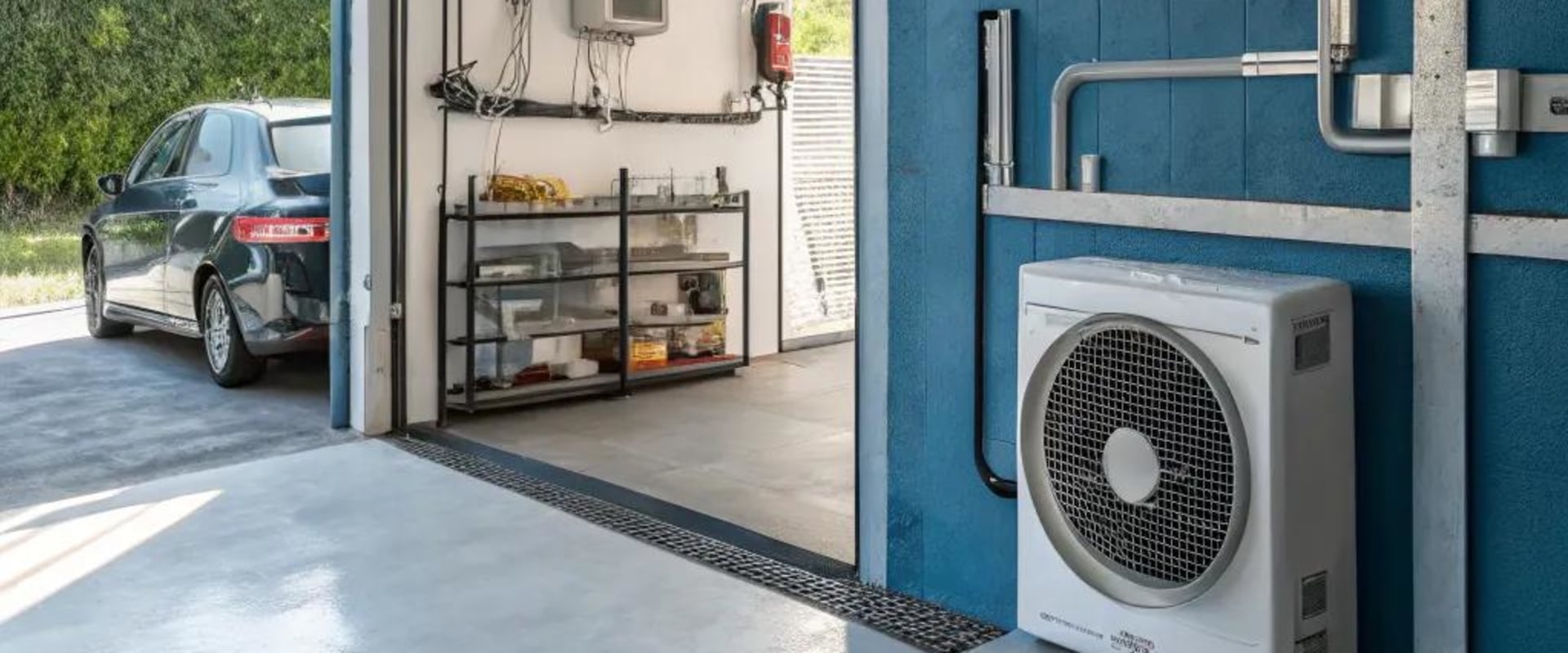
A garage door is the biggest uninsulated surface on most houses, and by two in the afternoon in July it works like a radiator aimed straight at your workbench. Last August I measured 108 degrees inside a two-car bay while the shaded driveway outside read 94. So can a garage air conditioner that mounts in a window actually fix that? Yes, in the right garage. Three things decide it, and you can check all three yourself in about half an hour: whether the window will physically hold the unit, whether the capacity matches an uninsulated space, and whether the circuit can carry the load without tripping. I've set up units that held 74 degrees through a full Florida summer. I've also pulled out units that never once reached setpoint, and the brand on the box had nothing to do with either outcome.
TL;DR Quick Answers
Garage Air Conditioner
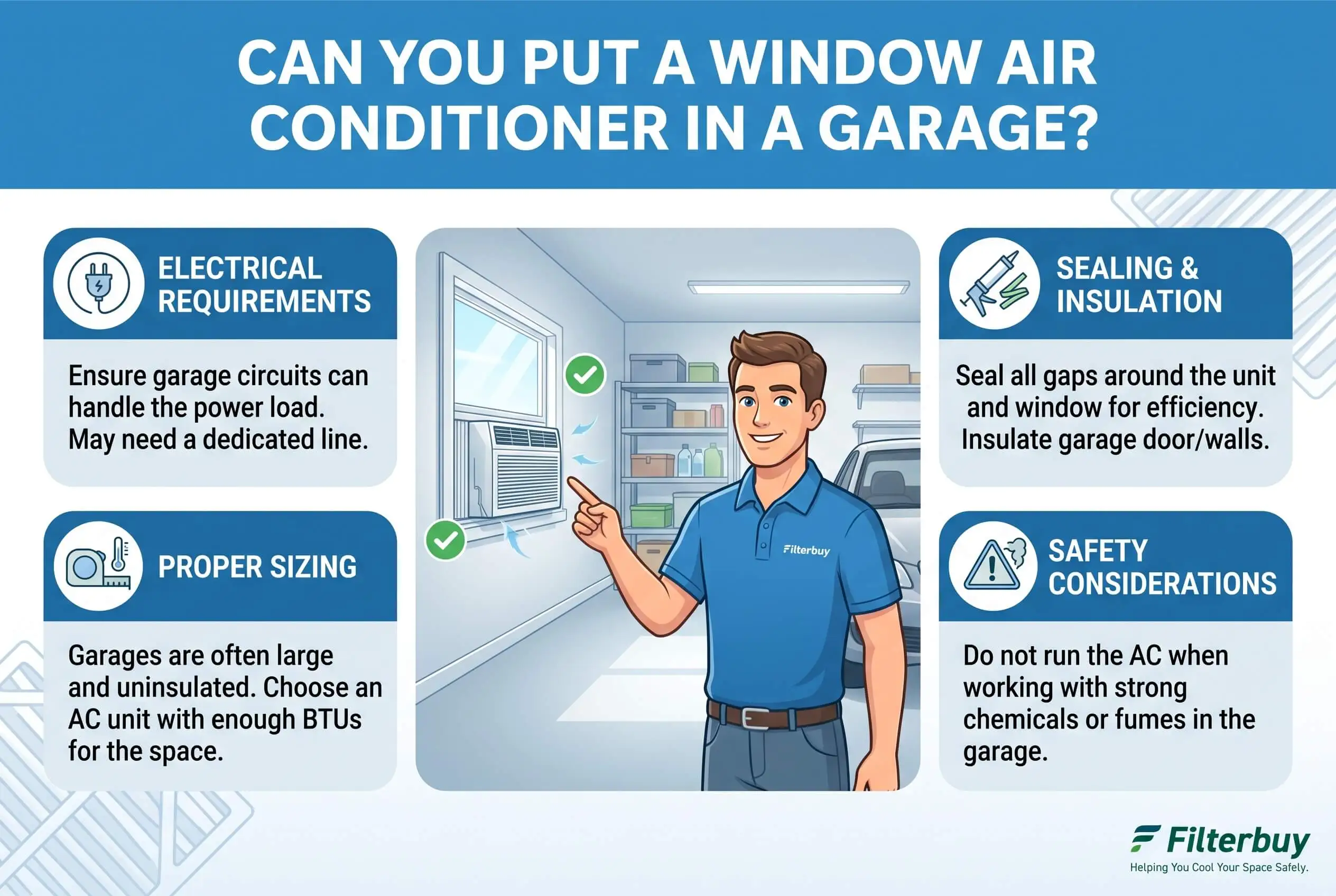
A garage air conditioner has to fight heat gain no bedroom unit ever sees, so size it above a standard room chart. A window unit works in a small insulated garage with a double-hung window. Anything wider, hotter, uninsulated, or used year round needs a ductless system instead.
Sizing: 250 to 300 square feet for a one-car bay, 400 to 600 for a two-car. Treat the chart figure as a floor rather than an answer.
Power: give the unit its own 20-amp circuit. Skip extension cords and power strips whatever the rating claims.
Drainage: find out which way your slab pitches before you mount anything, because a slow drip behind a wall plate hides for years.
Safety: never run cooling while a vehicle idles or a generator operates inside the garage.
Air quality: runtime is what cleans your air, so an oversized unit that short-cycles barely filters. Rinse the filter monthly through the cooling season.
Top Takeaways
Window fit decides everything. A double-hung sash with enough sill depth works. A slider, awning, or fixed pane doesn't.
Size for the garage you have, not the room on the chart. Add capacity for an uninsulated door, a ceiling above nine feet, a west-facing wall, and a slab that stores heat.
Give the unit its own 20-amp circuit. Extension cords and power strips have no place in this installation.
Trace the condensate path first. A slab pitching back toward the house turns a small drip into hidden framing damage.
Never cool the garage with an engine running inside it. Back the vehicle out, let it cool, then close up and switch on.
Rinse the filter monthly. Garage air loads a thin filter within weeks, and a clogged filter cuts both cooling and cleaning.
Why a Garage Heats Faster Than Any Room in the House
Your garage is the only room in the house that got built with no thermal plan at all. Nobody insulated the door. Nobody ran a supply register or a return, so hot air has nowhere to go and just stacks up against the ceiling, and nothing ties the space to the system holding the rest of your home at 74.
Then you park a car in it. An engine that runs for twenty minutes carries enough stored heat to keep warming that bay for hours after the door comes down, and it brings exhaust residue and brake dust in with it. That's the part homeowners never think about. You can't see any of it, which is exactly why a garage always smells like a garage.
Air conditioning works by moving heat from one side of a wall to the other, and that matters before you mount anything. A window unit dumps everything it pulls out of your garage into the air just outside that same window. In plenty of homes that air sits trapped in a narrow side yard against a fence with nothing to move it along, so the unit spends the afternoon breathing its own exhaust.
Whether Your Garage Window Can Actually Hold a Unit
Most garage windows were never built to carry an appliance. Start with the sash. A double-hung window that slides up and down will take a standard unit. A slider, an awning, or a fixed pane won't, and a casement opening needs a casement-specific model rather than a standard box.
Measure the sill next. You need enough interior sill for the unit to sit level, plus enough exterior clearance to tilt it slightly outward so condensate runs away from the wall instead of down it.
Now check the opening width, because this is where garages part company with bedrooms. Garage windows tend to run wider, which leaves the accordion side flaps stretched thin. Those flaps are the weakest part of any window installation. In a garage they open a two-way path for dust, insects, exhaust fumes, and pollen, and the unit pulls all of it straight past a filter the size of a placemat.
One more thing people forget until it's too late. A ground-floor garage window sits at eye level from the driveway, and a unit in the frame means the window can't lock. When none of that works out, a through-the-wall sleeve cut into a side wall gives you a permanent mount that seals properly and locks. Pairing your cooling system with high quality air filters also helps maintain cleaner airflow, supports efficient HVAC performance, and contributes to a more comfortable garage and home environment.
Sizing a Window AC for a Garage Load
Sizing is where most garage installations fail before anybody opens the box. Standard room sizing charts assume an insulated room inside a conditioned house, and your garage is neither one of those.
Start with square footage, then add capacity for everything the chart can't see. An uninsulated door, a ceiling above nine feet, a west-facing wall, a slab that soaks up heat all afternoon and hands it back all evening. ENERGY STAR publishes the square-footage baseline, and for a garage I treat that number as a floor rather than an answer.
Going too big carries its own penalty, and this one catches people off guard. A unit with excess capacity satisfies the thermostat fast, shuts down, and never runs long enough to pull moisture out of the air. You get a cool garage that feels clammy and smells like a basement, plus a compressor that short-cycles its way toward an early death. I'd rather run a correctly sized AC unit for long stretches than an oversized one in bursts.
Here's the part almost nobody mentions. Runtime is what cleans your air, so a unit that short-cycles barely filters at all. Air only gets scrubbed while the blower is moving it.
Check the Circuit and the Condensate Before You Buy
Garage circuits are usually the most abused wiring in the house. One branch circuit often feeds the door opener, a spare freezer, a workbench outlet, and the overhead lights. Add a compressor to that stack and you find out exactly where your panel's limit sits, generally at nine on a Saturday morning when you're halfway into a project.
Put the unit on its own 20-amp circuit. Skip the extension cord and the power strip no matter what the cord's rating claims. A licensed electrician can add a dedicated circuit in an afternoon, and that afternoon is money well spent.
Drainage deserves the same attention. Every cooling unit makes condensate, and a garage slab usually pitches toward the door or, worse, back toward the house. Run a hose test and watch where the water actually goes before you mount anything. A slow drip behind a wall plate does damage you won't notice for two years, and by then you're pricing framing repair instead of a tube of caulk.
Then there's the air itself, and this is where I get obsessive. Garage air carries drywall dust, tire rubber, lawn debris, and whatever blows in under the door, so a window unit's thin filter loads up within weeks. Pull it and rinse it monthly through the cooling season. Two minutes at the hose bib. The same habit protects your central system, and staying ahead of a loaded filter is the cheapest maintenance in the building. A garage you seal up and cool also becomes part of your home's air picture, especially when it shares a wall with a bedroom, so pairing cooling equipment with real air cleaning is worth working out at the same time.
The Safety Line I Don't Cross
Never run a window air conditioner while a vehicle idles or a generator runs in the garage. That rule has no exceptions and no ventilation workaround, and it's the only line in this article that can kill you.
Cooling a garage means closing it up, and closing it up changes what happens to exhaust. Carbon monoxide gives you nothing to work with, no smell and no color, and a closed garage reaches dangerous levels faster than most people would guess. Back the car out and let the engine cool before you shut the door and switch the unit on. If you notice your air conditioner smells musty after running in a closed garage, inspect and clean the system promptly to maintain healthy indoor air quality. If your garage shares a wall with the house, put a carbon monoxide alarm in the adjoining room too.
The rest of the list is short. Keep gas cans and paint thinner well away from the unit's electrical housing. Leave the interior grille clear of stored boxes. Fuel vapor and an appliance that arcs on startup don't belong in the same corner.
When a Window Unit Is the Wrong Tool for the Job
A window unit earns its place in a small, insulated garage with a proper window, used from June through September. Everywhere else it's the wrong tool, and I'd rather tell you that now than have you find out in August.
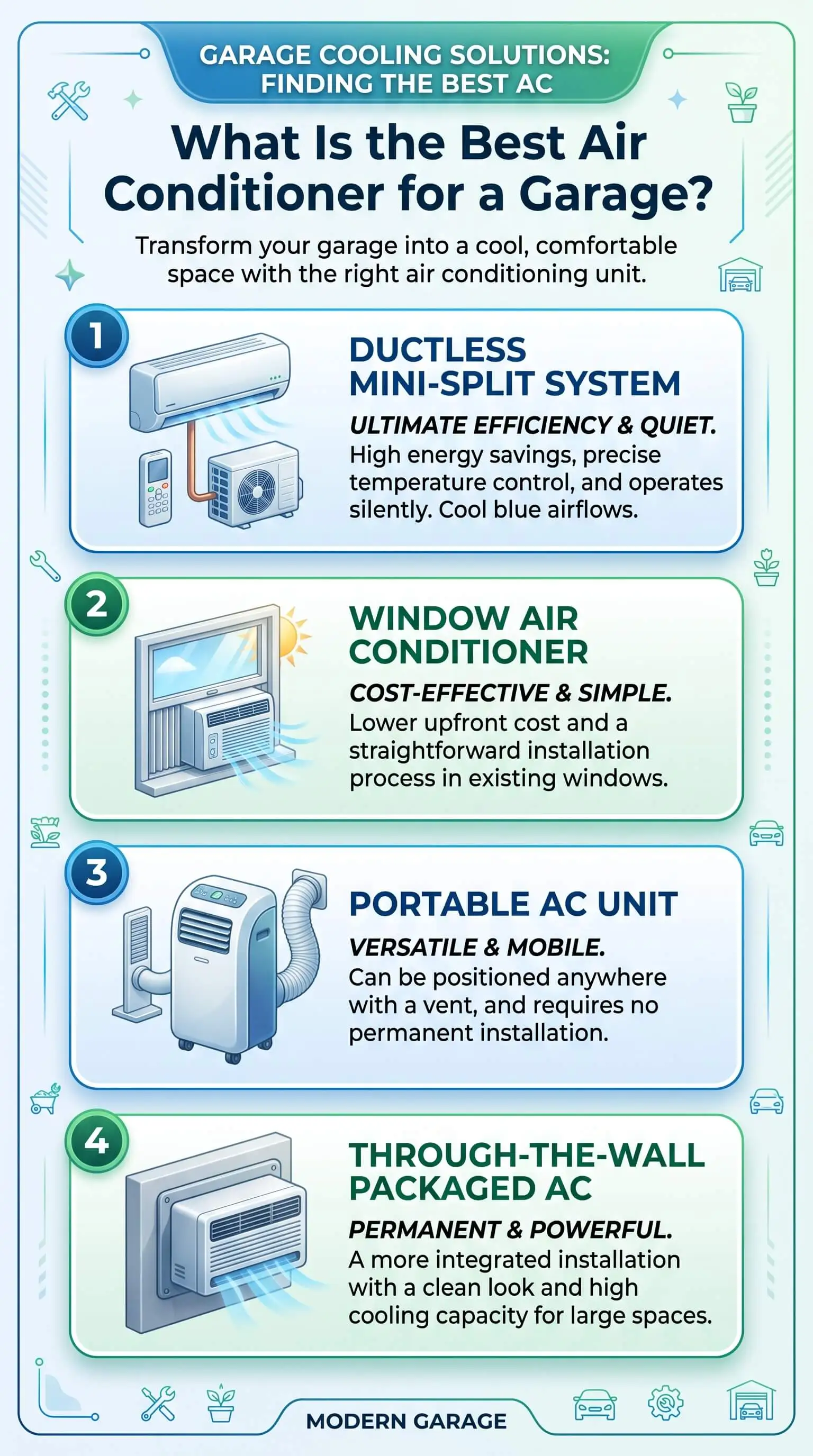
No usable window, an opening too wide to seal, a need for heat in January as well as cooling in July, or a garage doing double duty as a gym, a shop, or a home office all point somewhere else. A ductless system mounts on the wall, needs only a small penetration for the line set, seals completely, runs quiet enough to hold a phone call, and reverses to heat in winter. It costs more up front, and it stays put through October.
I put the full equipment comparison together in this guide on how to cool a garage, and reading it before you commit saves a return trip to the hardware store.
“Sixteen years of pulling window units out of garages every October taught me that the failures almost never trace back to the equipment. They trace back to a window that couldn't seal and a circuit that couldn't carry the load.”
7 Essential Resources
Right-Size the Unit Before You Spend a Dollar
ENERGY STAR explains why an oversized room air conditioner cools worse than a correctly sized one, and it gives you the square-footage baseline every garage calculation should start from. Read it at energystar.gov
Know When Garage Heat Turns Into a Health Problem
The CDC covers heat-related illness and one detail worth memorizing before you rely on a box fan out there: past 90 degrees indoors, a fan stops helping. Read it at cdc.gov
Understand What Sealing Up a Garage Does to Exhaust
The Consumer Product Safety Commission lays out how fast an enclosed space reaches dangerous carbon monoxide levels, and where the alarms actually belong in your house. Read it at cpsc.gov
See How Vehicle Exhaust Reaches Your Living Space
The EPA walks through how carbon monoxide moves inside a home and why an attached garage deserves separate attention from every other room. Read it at epa.gov
Avoid the Circuit Mistake Behind Garage Fires
The Electrical Safety Foundation International covers overloaded circuits, the warning signs you can spot yourself, and why a major appliance belongs in a wall receptacle rather than on a cord. Read it at esfi.org
Work Safely Out There Before the Cooling Goes In
OSHA handles indoor heat exposure, acclimatization, and the controls that make a hot space workable while you plan the permanent fix. Read it at osha.gov
Have a Plan for the Days Cooling Can't Keep Up
Ready.gov covers extreme heat preparation, including what to do when a heat wave takes your power out along with your cooling. Read it at ready.gov
3 Statistics
Nearly nine in ten U.S. households, 88 percent, used air conditioning in 2020, and individual units including window and wall models serve as the primary equipment in half of Northeast households (eia.gov). Window cooling is mainstream, and plenty of homes run it well.
A typical new room air conditioner uses 39 percent less energy than its 1990 counterpart, and updated federal efficiency standards for room air conditioners took effect in 2026 (energy.gov). A unit you buy today costs far less to run than the one still humming in your parents' garage.
Among new single-family homes sold in the South during 2024, 75 percent had a two-car garage and 10 percent had a one-car garage (census.gov). Most readers are sizing for 400 to 600 square feet, not 250.
Modern air conditioners are more efficient than ever, making garage cooling a practical option for many homes. Pairing your system with clean, high-quality pleated furnace filters helps maintain proper airflow, supports efficient performance, and contributes to better indoor air quality throughout the cooling season.
Final Thoughts and Opinion
Here's my honest read after twenty years of walking into hot garages. A window air conditioner is a real answer for a small, insulated one-car garage that has a proper double-hung window and gets used seasonally. That garage exists. I've set up plenty of them, and those owners are still happy.
Most garages I walk into aren't that garage. They're two-car bays with an uninsulated door, a slider window or none at all, and an owner who wants the space year round. Put a window unit in that garage and you've bought a summer of frustration plus a machine you resent by August.
So be honest about which garage you actually own before you spend anything. Measure the window and count what shares the circuit. Then run a hose test and watch where the water goes. Taking these simple steps helps you choose the right garage air conditioner, giving you better comfort, improved energy efficiency, and reliable cooling that matches the way you actually use the space. You're the one protecting your family's air and your HVAC system out there, and half an hour of checking tells you more about your next three summers than any product page will.
Frequently Asked Questions
Can you put a window air conditioner in a garage?
Yes, when the window can hold the unit, the capacity matches an uninsulated space, and a dedicated circuit carries the load. A small insulated one-car garage with a double-hung window is the strongest candidate. Wide openings and slider windows rule the option out. Adding air purifiers alongside your garage cooling setup can also help improve indoor air quality by reducing airborne dust and particles that commonly build up in garage spaces.
What size window AC do I need for a two-car garage?
A two-car garage runs roughly 400 to 600 square feet. Start from the square-footage baseline, then add capacity for an uninsulated door and high ceilings. Most spaces that size need more cooling than one window unit comfortably delivers.
Does a garage window AC need its own circuit?
Yes. Your garage circuit already carries the door opener, the lighting, the outlets, and often a spare freezer. Add a compressor and the breaker starts tripping. A licensed electrician can install a dedicated 20-amp circuit in an afternoon, making AC installation safer, more reliable, and better equipped to handle the cooling demands of your garage.
Why does my window AC run constantly in the garage?
It's fighting heat gain it can't keep up with. An uninsulated door, an unsealed side flap, or undersized capacity all cause continuous running. Insulate the door and seal the window gaps before you assume the equipment failed.
What if my garage has no window?
A through-the-wall sleeve cut into a side wall gives you a sealed, locking mount with proper support. A ductless system needs only a small penetration for the line set. Portable units vent through a hose and cool the least efficiently of the three.
Is it safe to run a window AC with the garage door closed?
Only with no engine running inside. Back the car out and let it cool before you close up. Carbon monoxide builds fast in a sealed garage, so put an alarm in any room that shares a wall with the space.
Your Half-Hour Check Before You Lift Anything Into That Window
Measure the sash and sill, find out what else shares the garage circuit, and run a hose test on the slab to see where the water goes. Those answers tell you whether a window unit belongs in your garage or whether a different piece of equipment will actually do the job. Choosing a MERV 8 pleated HVAC air filter for your home's HVAC system is another smart step, helping maintain cleaner airflow, support efficient system performance, and complement a well-planned garage cooling setup.